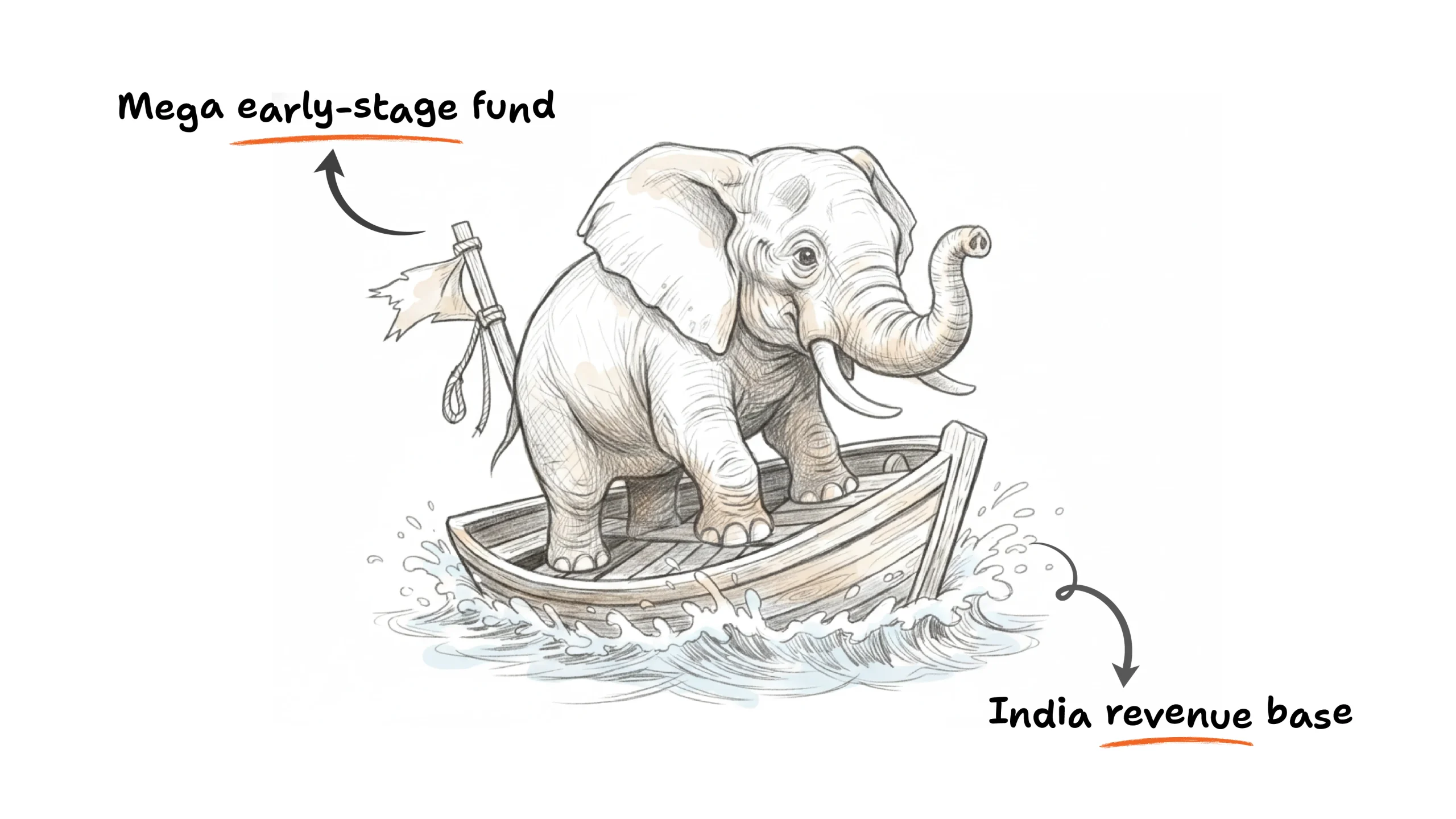
Several large new funds have been announced in India recently. Some approach or exceed a billion dollars. Most describe themselves, in some form, as early-stage investors.
I want to offer a reality check. Not a critique of India, and not pessimism. The entrepreneurial talent here is exceptional, and there are real businesses being built. But there is a specific structural problem with very large funds deploying at an early stage in India’s domestic market, and I think it deserves to be said plainly.
Before making the argument, let me give credit where it is due.
The early investors in Zomato, Swiggy, Paytm, and Ola were pioneering. There was no playbook. Smartphone penetration was just beginning. UPI did not exist. Whether an Indian consumer would order food through an app, hail a cab digitally, or trust a wallet with real money were genuinely open questions. Somebody had to test the thesis, and the investors who did it wrote cheques sized for discovery, not deployment.
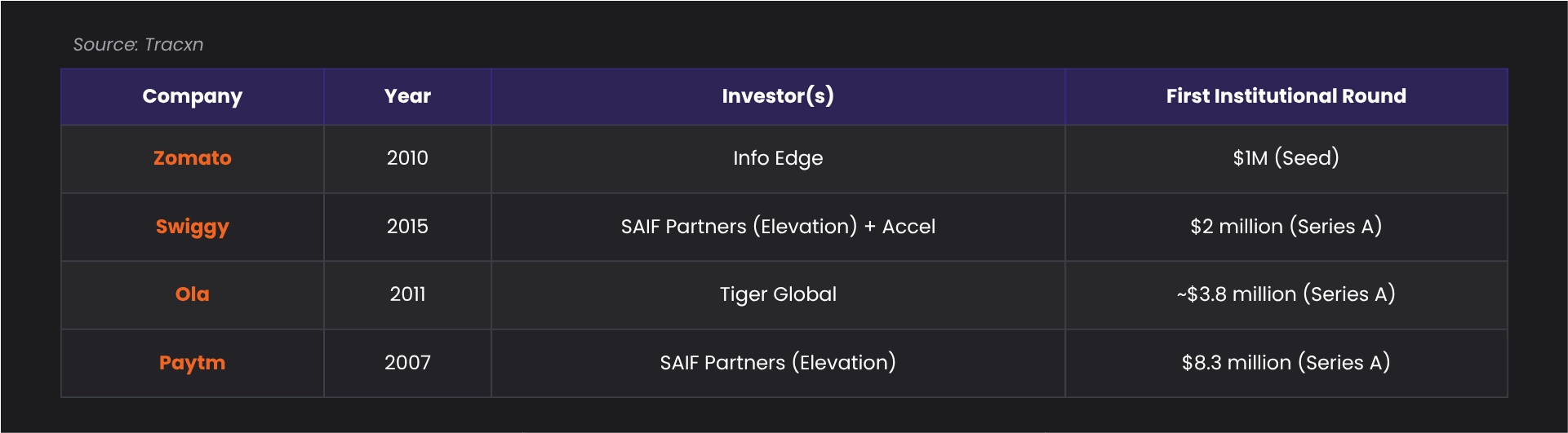
Small, disciplined, appropriately sized bets into sectors that had never been tested in India. Many of those bets were right, and they generated real returns at the fund sizes those managers were running.
The problem we face today is categorically different. Those markets have now been tested. The data is in. We know what food delivery revenues look like at scale. We know how long it takes payments companies to become profitable. We know what families will actually pay for edtech. And yet new funds are announcing themselves as “early stage” while raising amounts that make the original Sequoia India and Blume India fund sizes look like rounding errors.
The $1 Billion Filter and the Shared Fiction
Here is something everyone in the industry knows but rarely says openly. When reviewing pitch decks, a SAM or SOM below $1 billion rarely gets a serious look. It is treated as a signal of insufficient ambition. Below that number, the meeting often does not happen.
The problem is that in India, a $1 billion SAM is not the honest market reality in most sectors. So founders construct it. They apply the most generous market definition, layer in optimistic penetration assumptions, and arrive at a number that clears the filter. The VC knows the number is likely inflated, nods along anyway, and the whole process proceeds on a shared fiction that neither side has incentive to challenge.
This convention was built for the US market. Imported into India uncritically, it produces inflated market narratives across the entire ecosystem, right at the top of the funnel, before a single rupee has been deployed.
Byju’s is where this logic arrived at its most extreme destination. The edtech narrative wrote itself: 250 million school-going children, cultural obsession with exam preparation, inadequacy of government schooling. The deck was compelling. The SAM implied by a $22 billion valuation was enormous. Everyone believed the spreadsheet far longer than the revenue line warranted. Indian families were not going to pay Rs 30,000 to 50,000 a year on subscriptions at the scale the model required. That is the lesson. Not just bad governance. A market that was never the size the slide said it was.
Valuations move with sentiment. Revenues are what customers actually paid. Here is what India’s most significant VC-backed companies have actually generated.
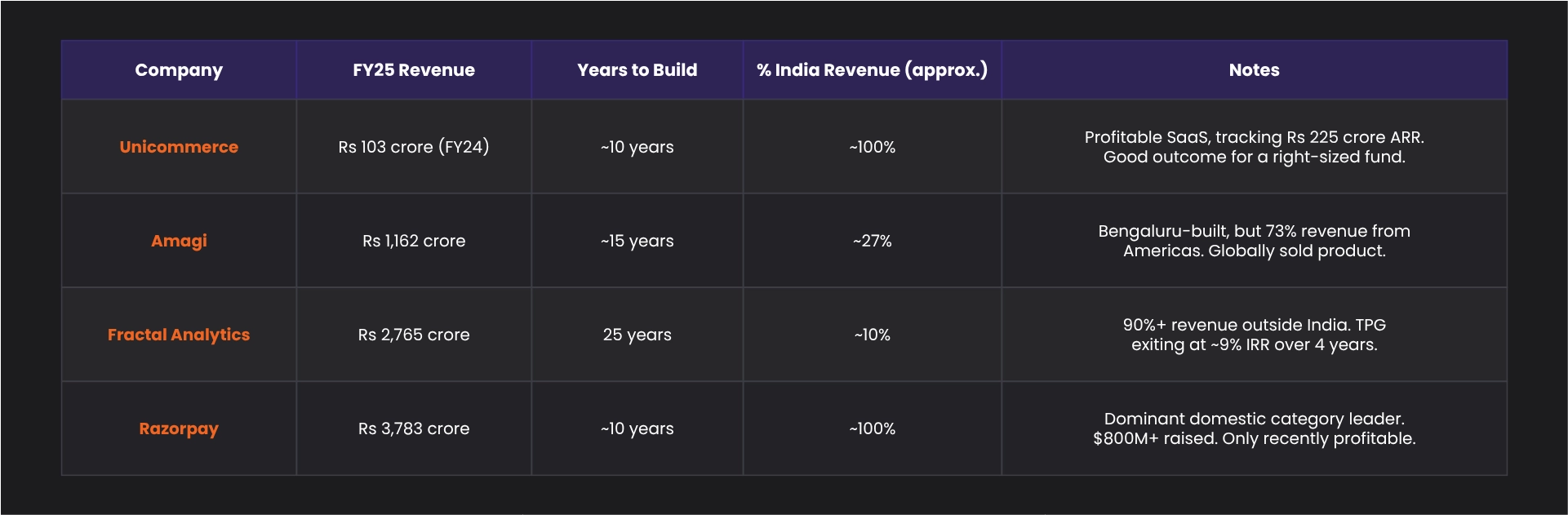
The pattern is consistent. Companies that reach large revenues either serve global markets, take a very long time to get there, or consume substantial capital along the way. Often all three. The domestic consumer ceiling appears much earlier than SAM slides suggest.
The Premiumisation Trap
The standard rebuttal is India’s growth story. GDP at 7 to 8 percent. The rising middle class. The premiumisation thesis: India’s high-income consumers are trading up across categories, and companies targeting higher AOVs are riding a structural wave.
The premiumisation trend was real. Post-COVID, there was a visible and genuine uptick. SUVs above Rs 10 lakh crossed 48 percent of all passenger vehicle sales. Premium experiences surged. The data supported the narrative.
But here is something those of us in this consumer cohort are now feeling directly: everything has gotten more expensive, faster than the inflation numbers suggest. Cars, housing, food, clothes. The official CPI basket does not capture what this cohort actually spends on, so the squeeze is real but invisible in the headline data.
More importantly, the cohort is finite. India’s genuinely premium consumer, the one with consistent discretionary income to deploy across multiple categories, is probably 30 to 60 million people. Right now, hundreds of brands and dozens of VC-backed startups are all pointing their targeting algorithms at the same finite group. The person being sold premium D2C skincare is the same person being sold the premium gym membership, the premium grocery subscription, and the premium co-working membership. That is not market expansion. It is a fight for wallet share among an already-saturated spender. Companies that built revenue projections on this cohort expanding will find the growth curve flattens well before the SAM implied.
An example of this is Uber India, which is a clear market leader in its category and only doing around INR 800 cr revenues from the ride hailing business.
The Fund Math, in Revenue Terms
Return expectations are not flat across fund sizes. Smaller funds, typically backed by family offices, HNIs, and entrepreneurial LPs, need to deliver 3x to 3.5x net to justify the illiquidity and risk. Larger funds with institutional LP bases: pension funds, sovereign wealth funds, large endowments are often targeting 2x to 2.2x net, prioritising capital preservation and predictability over maximum return. The bar is lower. But so, critically, is the acceptable risk.
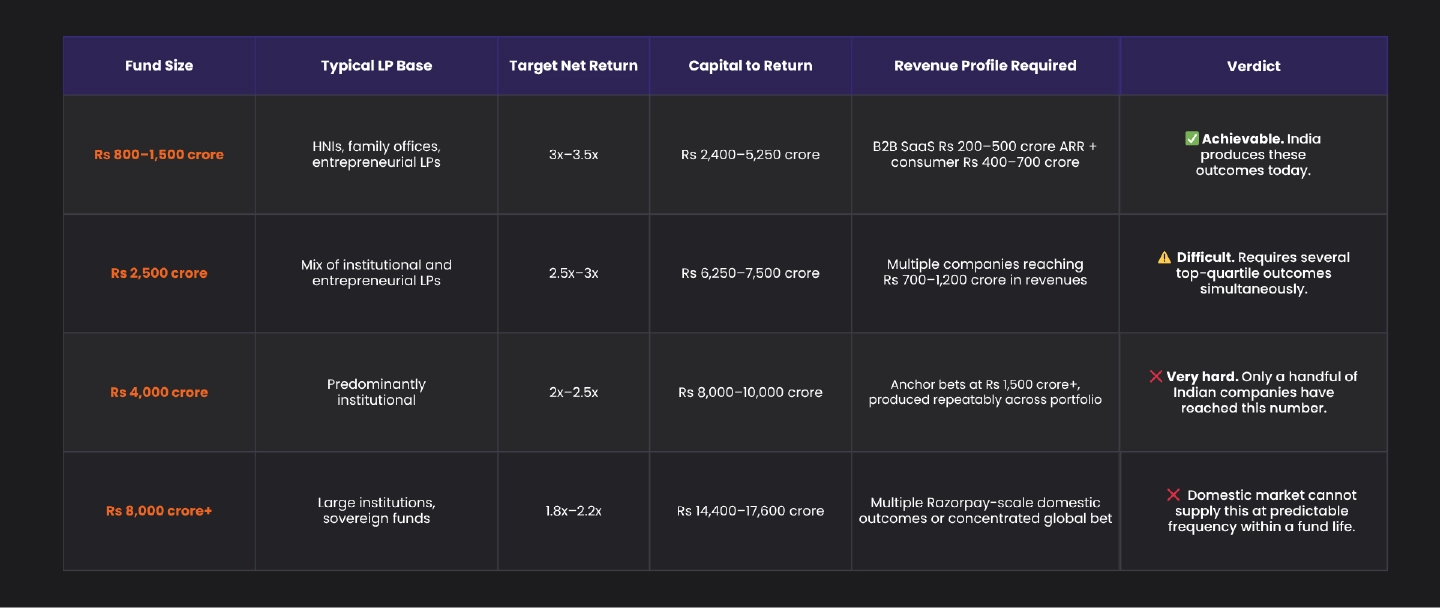
The lower return expectation at larger fund sizes softens the math somewhat but does not resolve it. Returning Rs 14,000 crore from India’s domestic startup ecosystem within a 10-year fund life still requires a concentration of large revenue outcomes that the market has not yet demonstrated the ability to produce reliably. And if the fund is counting on global revenue to fill the gap; companies like Amagi, Fractal, or an Emergent, it runs straight into the SEBI/RBI constraint discussed later.
There is also a deeper contradiction. Institutional LPs are okay with lower return because they want lower risk. Early stage is the highest-risk point in any company’s lifecycle. The instrument and the capital’s risk appetite are structurally mismatched from the start.
What “Early Stage” Actually Means When Your Fund Is This Large
Some larger fund houses have solved the discovery problem elegantly, by creating separate, smaller vehicles specifically for tracking early-stage companies. Blume has Founders Fund. Matrix has DeVC. These vehicles write small discovery cheques, maintain relationships with founders early, and create an option for the main fund to lead when conviction is established. It is a sensible structure.
But here is what it means for the main fund. If the tracking function is handled by a separate vehicle, the main fund still has to build a concentrated portfolio of 25 to 30 core companies. And it has to write cheques large enough to matter for its fund size. There is no escape from the deployment math.
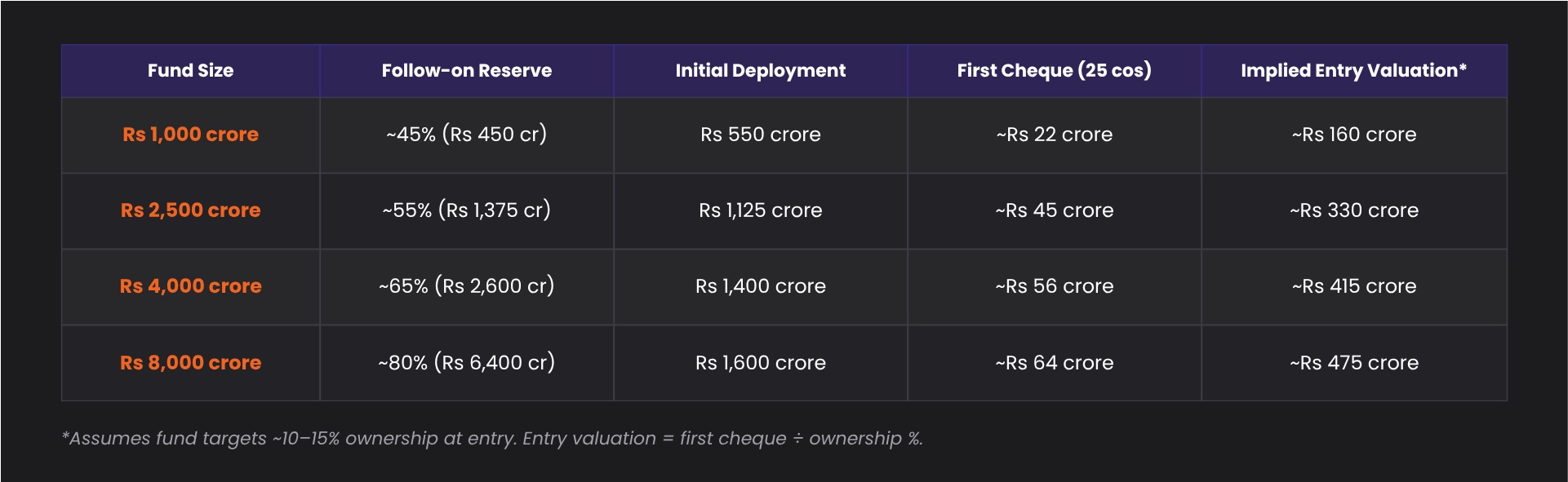
A market-rate seed in India today is Rs 5–15 crore at a post-money of Rs 35–100 crore. Even at the large end of the table, an Rs 8,000 crore fund’s implied entry post-money of Rs 475 crore is paying a price a company should only command after two to three years of demonstrated revenue. The tracking vehicle may have gotten in early and cheaply at Rs 50–80 crore post-money. But the main fund, where the bulk of capital sits, is entering at a valuation that already assumes the thesis has been validated. And note that across all fund sizes, the initial deployment available is actually not that different in absolute terms, ranging from Rs 550 crore to Rs 1,600 crore. What changes dramatically is the follow-on reserve, and with it, the pressure to double down into winners at increasingly stretched valuations.
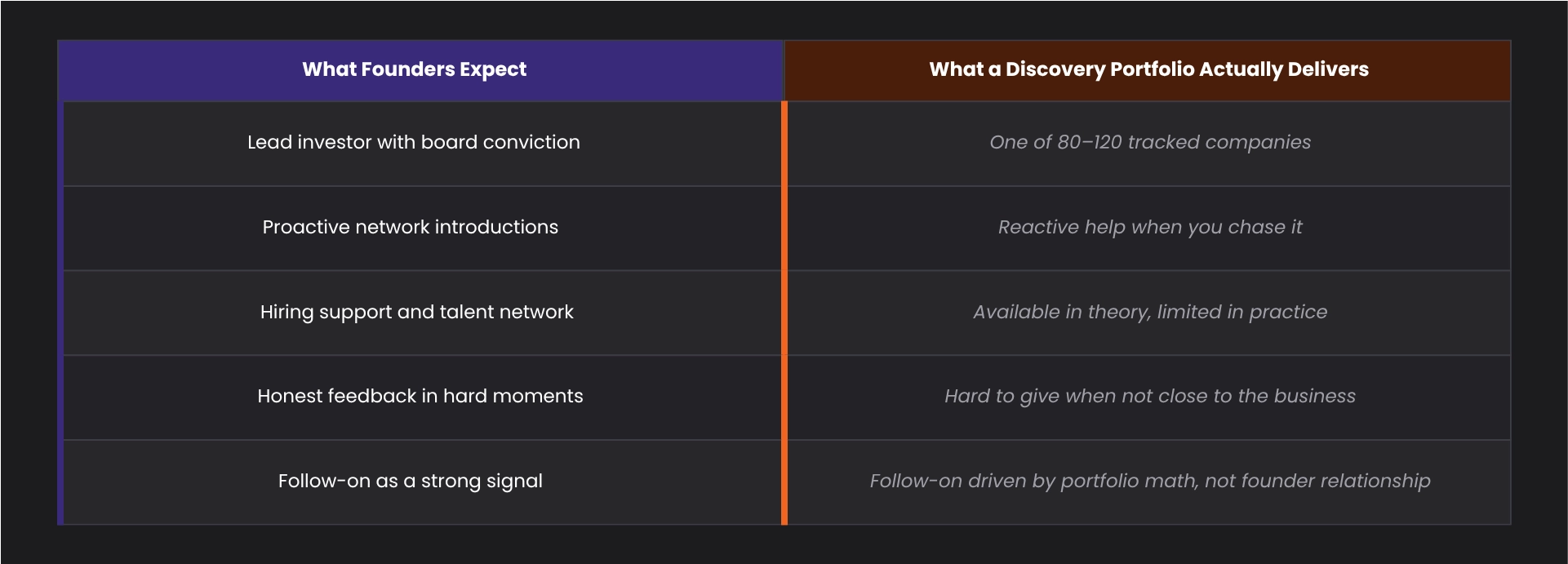
The follow-on dynamic compounds this. When a large fund does deploy its follow-on reserve into a breakout company, it is concentrating Rs 80–150 crore into a Series B or C at a valuation that may now be Rs 1,500–2,500 crore. Each round reinforces the number, brings in other funds who interpret the activity as validation, and makes it structurally harder to acknowledge when the revenue ceiling starts appearing. Capital concentrates in companies long after the market has started signalling it should not. This is the mechanism that turned 2021 into what it became.
A large fund deploying at growth stage is a far more coherent thesis. The lower return expectation fits the risk profile of demonstrated revenue. The follow-on reserve goes into companies where the ceiling is known, not speculated. And there are fewer companies to support, which means the support can actually be meaningful.
The One Strategy That Bypasses the Ceiling
There is a version of this story that does not have the revenue ceiling problem: Indian founders, Indian engineering, building for the world.
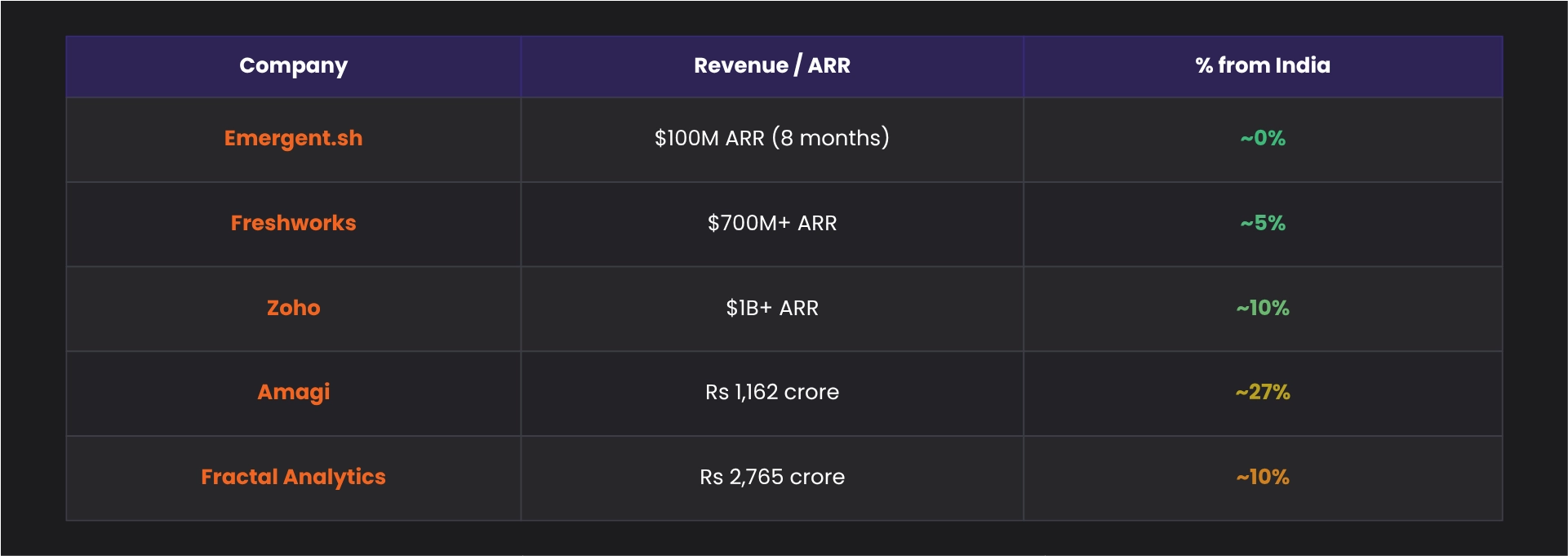
The SAM for these companies is the global software market. The domestic ceiling does not apply. The AI wave will accelerate this pattern dramatically.
The structural irony is that Emergent’s capital came from Khosla, SoftBank Vision Fund 2, Lightspeed, and Y Combinator, all offshore funds. Not because Indian managers lack conviction or relationships. But because SEBI and RBI regulations make it very difficult for India-registered AIFs to invest in US-incorporated companies. The aggregate industry overseas investment limit is exhausted. The thesis most capable of returning a large India-focused fund is the one Indian-registered funds cannot easily access. That is a policy problem worth taking seriously.
What the Ecosystem Actually Needs
India needs more well-sized early-stage funds. Rs 800 crore to Rs 1,500 crore, run by investors with domain depth, writing Rs 4 to 10 crore first cheques, building portfolios where return requirements match the revenues the market can actually produce. At that scale, a B2B company at Rs 200 crore ARR is a meaningful outcome. The math works without needing a Razorpay in every portfolio.
The early investors who backed Zomato for $1M and Swiggy for $2 million understood this implicitly. They sized their bets to match the uncertainty. Their fund economics worked because the cheque size and the market were in the same conversation.
What the ecosystem does not need is large funds with deployment pressure writing oversized seed cheques into companies that do not need the money yet, pulling valuations up across the board, and funding the assumption before the market has had a chance to test it. The Byju’s lesson is not just about governance. It is about what happens when capital is raised against a market that was never the size the deck said it was.
The market is real. The founders are world-class. But the revenue base of India’s domestic market has a shape, and that shape does not accommodate the return requirements of billion-dollar early-stage funds. Saying this is not pessimism. It is just honesty. And honesty, right now, is what the ecosystem needs more than another fund announcement.