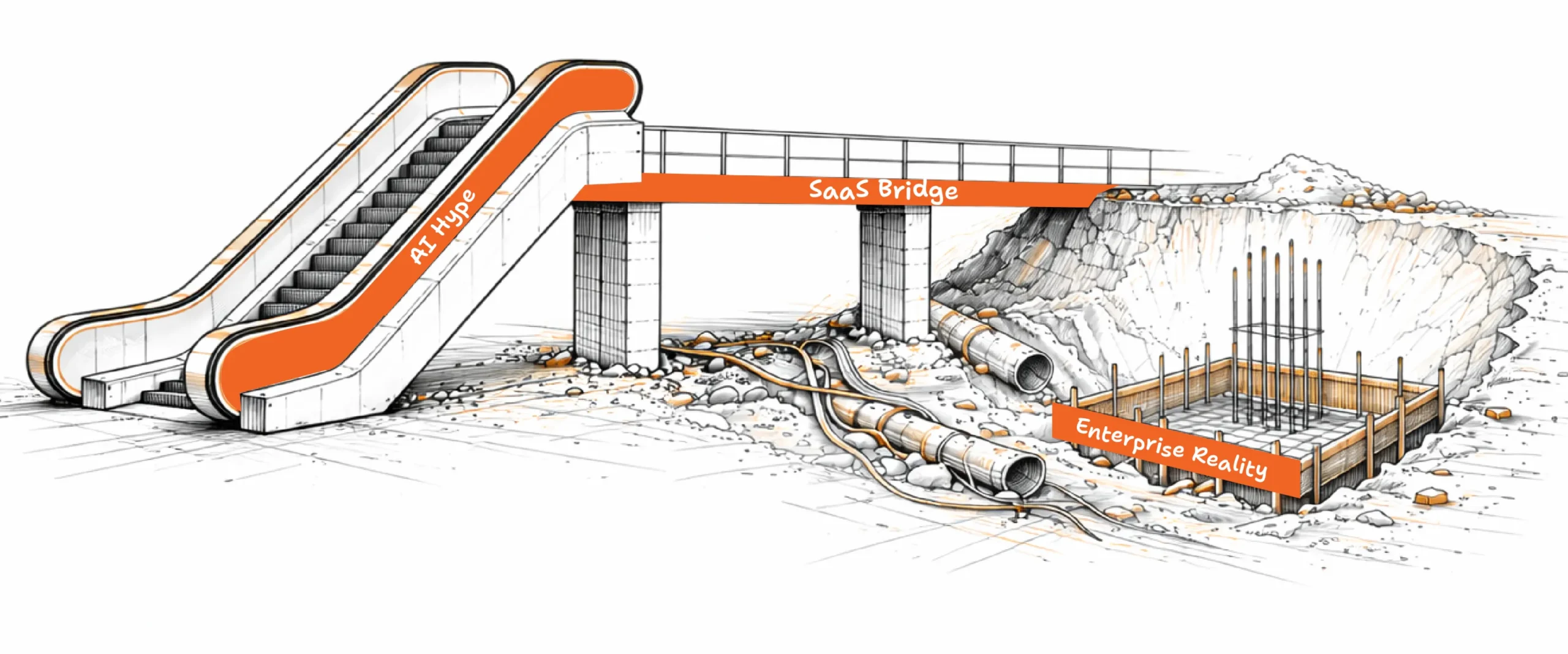

Every few years, technology hits a moment that forces everyone to pause and recalibrate. We’re in one of those moments again.
In just a few days, hundreds of billions in value disappeared from large SaaS, legal, and IT services stocks. The market was responding to the arrival of Claude Cowork capable of plugging into systems, spinning up plugins for legal, sales, finance, and support, and running entire workflows end to end.
Cowork can even build specialised agents quickly, which makes the fear very real for anyone whose product looks like a thin layer on top of these functions.
So if AI agents can increasingly do support work end to end, what happens to B2B tech products that were built to do exactly that across different verticals. Do they get replaced, absorbed, or strengthened?
Why a Use Case First Thesis Still Holds
My answer starts with something that has not changed. The strongest B2B products have always been use case first and domain first, not “AI first.” The founders who win know their vertical deeply and use technology including AI as the best available tool to solve a real, painful workflow.
Even before this wave, we were already seeing the old “seat based SaaS” model give way to transaction led and outcome based pricing. Customers were telling vendors very clearly that they did not just want access to software. They wanted to pay for work done or outcomes delivered. AI has only accelerated that shift. Agentic systems can now perform a meaningful share of the job, which makes it even more important that products are tied to real business results, not just usage or logins.
AI introduces risk and opportunity at the same time. You can be disrupted if your product is easy to recreate with a generic agent. You can also build deeper moats if you encode real domain expertise and operating context into your product in a way off the shelf tools will struggle to match.
Three Places AI Will Reshape B2B Companies
When I look at how serious teams can practically use AI, I see three broad buckets:
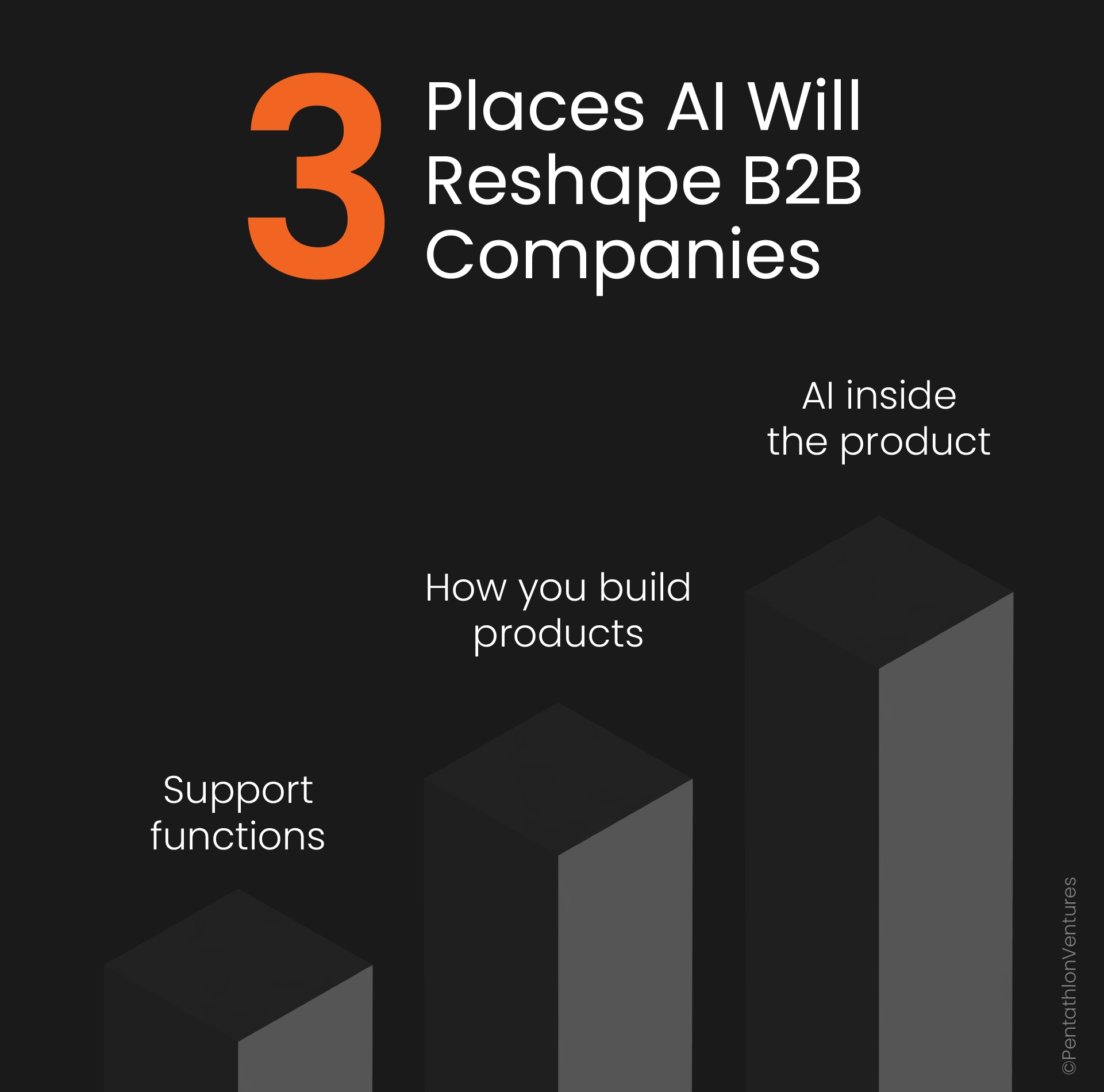
Support functions
This is the most visible and now the most crowded space. Tools like Cowork make it possible for non developers to automate legal reviews, compliance checks, basic finance workflows, and support tasks. It is obvious that every company should audit where they are spending human time on repeatable support work and ask whether an AI agent can do that faster and cheaper.
How you build products
Many teams started by letting individual developers and QA engineers use AI assistants to write new code. That helped with velocity, but it rarely solved the harder problem maintaining and modernising large, messy, legacy codebases. The path I believe in looks different. First, capture as much of the organisation’s existing knowledge as possible code, specs, decisions, and edge cases. Then use AI to refactor and rebuild products with that full context. That is how you move from “helpful snippets” to production ready systems that can be maintained over time.
AI inside the product
This is where the real strategic questions sit. For any product, you have to ask how the customer sees it. Is it a support function for them, or is it core to their business. If you are a support function, there is a real risk that over time the customer will try to assemble the same capability using tools like Cowork or other agents, especially if you are only adding a thin UI on top of generic workflows.
The way to respond is not to add a superficial AI feature and hope for the best. It is to become that function for the customer and own the outcome. That means designing the product so that it consistently delivers a reliable result at a given cost. And then using the best available AI under the hood to keep improving that reliability and efficiency.
If you are closer to the core of the customer’s business, the bar is higher but the opportunity is stronger. Here, your AI product needs to capture and operationalise the expertise inside the customer’s own organisation.
That is where niche domain knowledge becomes a real moat. In focused problem spaces, well designed, domain rich products can produce more accurate, more trusted outcomes than generic tools. Many enterprises will prefer a specialised vendor to building everything in house, even if they keep experts in the loop to validate the results.
Partnering With Platforms, Not Fighting Them
One more reality is worth stating clearly. AI will move fast, enterprises will not. Procurement cycles, compliance, security, and change management do not turn overnight. In sector after sector, adoption of new technology has lagged the technology itself by years.
That lag is narrowing but it still exists. Tools like Cowork are explicitly designed to compress the adoption curve by packaging AI into workflows and plugins. Yet CIOs and business leaders still have to worry about risk, governance, and integration with existing systems.
For focused B2B builders, this window is where you can deepen your advantage. In that window, the right move is often to partner with the large AI platforms, not position yourself as their competitor.
Treat them as infrastructure: a way to get better raw capabilities, cheaper and faster, while you stay responsible for the last mile where the real value lies in workflows, outcomes, and trust in a specific context.
The “AI storm” is real. Some categories will get commoditised, and shallow products will struggle. But the core of the thesis remains intact. If you know your domain deeply, solve a painful use case end to end, and are willing to rebuild your product around agents and outcomes, this is not the end of the story. It is the start of a harder, but much more interesting chapter.