I was recently preparing for a talk on the topic of AI. Deepseek had just happened, and everyone wanted to know how the world is going to change with this development. I remembered the series of 4 articles that I ended up writing last year, when we were trying to figure out how AI and GenAI were going to impact our world of B2B Tech start-ups.
And guess what I found in the conclusion of my 4th and the final article “The Pentathlon Approach to GenAI”: “We hope new technologies will emerge that will address the challenge with GenAI of huge data, computing and energy requirements. But in the meantime, startups that can blend other technologies and domain knowledge with GenAI to address this challenge would be the winners.” (https://www.linkedin.com/posts/gireendra_ai-genai-innovation-activity-7239172039398330369-BaRe )
And thus this follow-up article about the new world brought in by Deepseek. It made sense to cover in it the other big development in the AI world – Agentic AI. (I use the term broadly to cover AI agents and Agentic workflows with the ability to achieve desired outcome(s), although full autonomy may be too futuristic at this point.)
Deepseek has redefined the AI Game
Conventional wisdom held that only big tech giants could build Large Language Models (LLMs) due to their massive data, computing resources, and energy access. Deepseek has shattered that myth by showing better results with older GPUs at much lower costs, building and training new LLMs on top of existing ones. Now that they have done it, other players will devise even better ways of building low cost LLM’s.
Deepseek’s success proves that constraints can drive smarter, leaner solutions—just as India built the Param supercomputer when denied access to the Cray Supercomputer. Deepseek has even open-sourced all their smart engineering for everybody, kicking off a virtuous cycle. On the hardware side, Nvidia’s $3000 Personal AI Supercomputer further accelerates this democratization. These developments remove a big hurdle for India in our AI ambitions.
The Indian Government has a unique opportunity to build LLMs for local languages and contexts, leveraging our Digital Public Infrastructure. Some of our larger B2C players might build their own LLMs in the post-Deepseek world., However, our younger B2B startups should not be building LLM’s. They can create high-value solutions tailored to enterprise needs using their client data to fine-tune existing LLMs, apply reinforcement learning, build Small Language Models (SLMs) based on their domain-specific knowledge.
Agentic AI has made AI much more powerful
Only a few months back, although AI agents were being talked about, AI was mostly used for task level automation, as assistants to humans. They were limited to recommending but not being able to action those recommendations. Agentic AI is a big step forward in this respect. Given a job to do, agents can themselves get information required for that job and complete it by executing entire workflows! And then a combination of agents can run entire functions, if not entire companies!
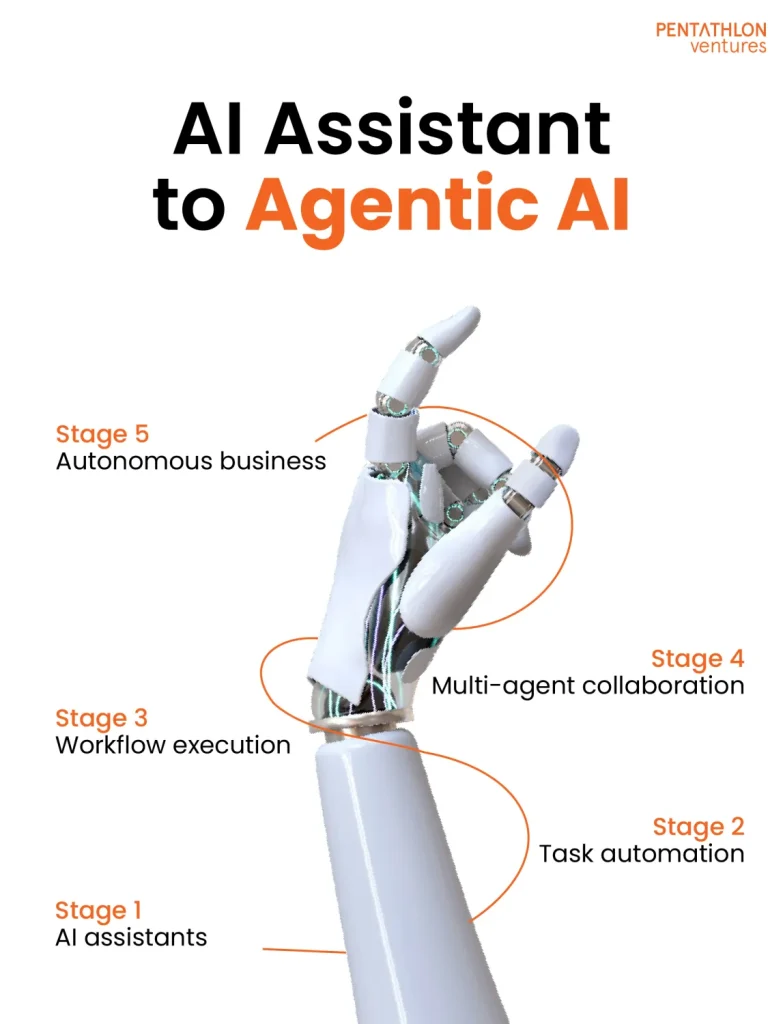
Once the agents start collaborating with each other, they will not just automate manual workflows, they will implement the use cases in much more efficient ways that may not be possible for us humans to even think of. Here is a post by Monish Darda of Icertis, with a great example of how Agentic AI is transforming the business use case of contract management.
https://www.linkedin.com/posts/monishdarda_ai-agents-activity-7300311687620943872-MkcK
The Deepseek effect here will be the participation of many more and nimbler competitors in the ecosystem, pushing everyone to do better. Some may build in the niches of their domain expertise, some others for horizontal use cases of security and privacy etc.
The opportunity for B2B Tech startups is getting bigger by the day
Even in the pre-Deepseek world, we saw the opportunity for B2B Tech startups in building AI applications for enterprises, as the enterprise data required for building them would be with the enterprises and not the Tech giants. If the startups have the domain knowledge (in addition to the GenAI expertise) they could build better AI apps for the enterprises than the Tech giants!
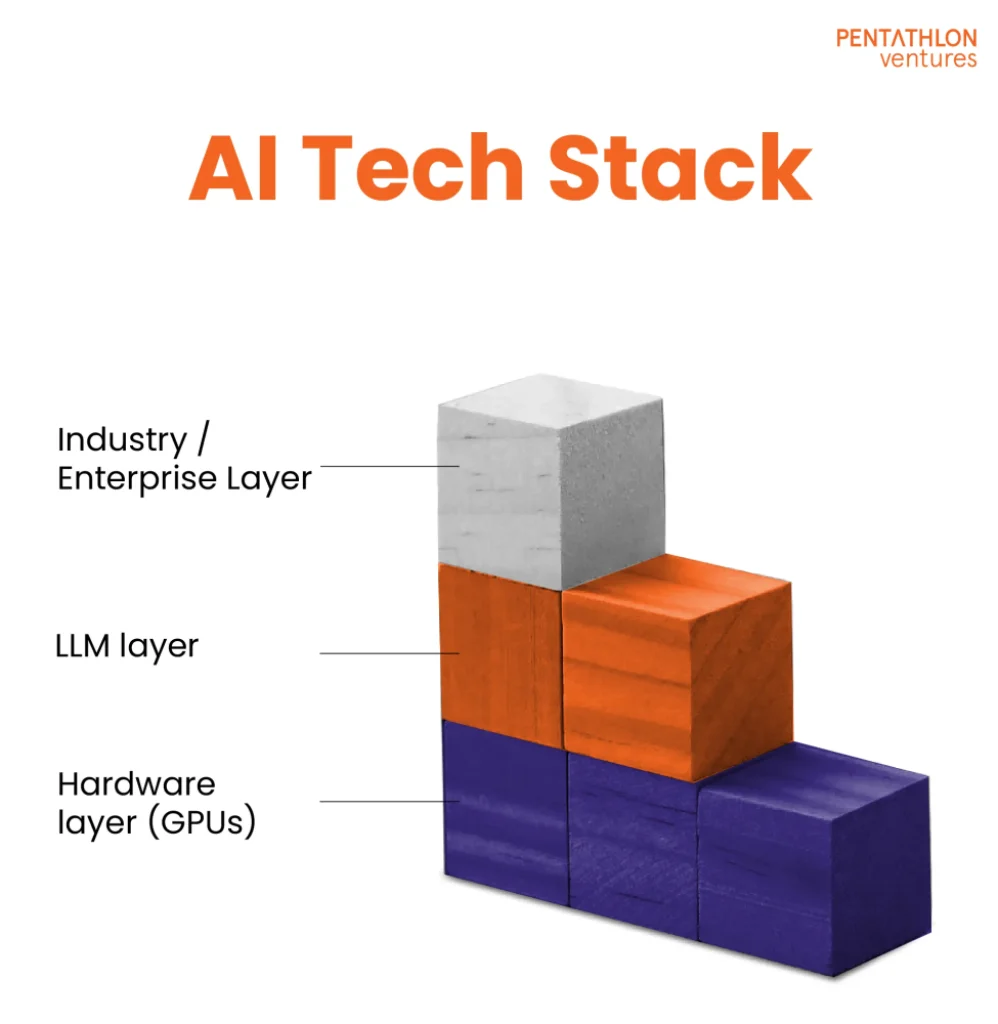
Our advice to start-ups was not to focus on the lower layers of the AI Tech stack (GPU’s and LLM’s) but on the layers above them of industry and company specific data. That’s where the domain knowledge should allow them more efficient approaches such as SLM and GraphRAG at inference time (as opposed to at the time of training the model). Interestingly, with the subject matter expertise being provided on tap for many subjects by GenAI, the differentiating domain knowledge would be the enterprise knowledge – workflows, integrations, the higher reliability and robustness expectations etc.
Now with GraphRAG, these AI systems can actually “learn” at inference time by updating the graphs and have better “do’s and don’ts” guardrails for the future. Enterprises will need this much more than consumers. They will also need explainability and accountability, which B2B companies will have to take extra effort to provide. So, while software development may become commoditised, Engineering would be much more important and differentiating. And with open sourcing of models for specific verticals, we see a much larger number of B2B Tech startups finding their niches and becoming successful with agentic AI.
They will continuously learn and improve their outcomes to meet the rigorous expectations of the enterprises. On the other hand, the Tech giants with their LLM’s will serve the larger populations, or individual users in the enterprise world.
In other words, the democratization of AI!
The Pentathlon approach remains focused on customer outcomes
Naturally, we are thrilled! And with good reason. Deepseek might be the poster child for now, but they’re not the only ones. Their open-source policy has triggered a flood of innovation that disrupts the LLM layer of the AI stack. WIth the hardware prices dropping significantly thanks to Nvidia and co, the hardware layer also gets disrupted.
So, what does that mean for startups? A new level playing field that facilitates them instead of blocking them. But differentiation for start-ups will continue to be in the application layers of the AI stack, by capturing niches with their industry knowledge. For those use-cases, they will create complete solutions providing reliable outcomes for their enterprise customers. These solutions will include AI agents, of course, but also hardware and human agents as required.
Is SaaS dead because of AI? Software-as-a-Service, as we knew it, was evolving already (seat-based pricing, for example, was giving way to transaction-based pricing). But with AI, SaaS becomes Solutions-as-a-Service, which will be measured by (and paid for) its outcomes.
The real winners? In addition to the industry knowledge, they will be GenAI experts, who can engineer the solution correctly, selecting the right mix of LLM’s and using various AI algorithmic techniques as appropriate. Further agentic AI allows them to expand into adjacent spaces by collaborating with other AI agents. The winners will consolidate them, offering even more comprehensive solutions to enterprise customers.
We are just happy that our young B2B Tech startups will have a shot at becoming those big winners.