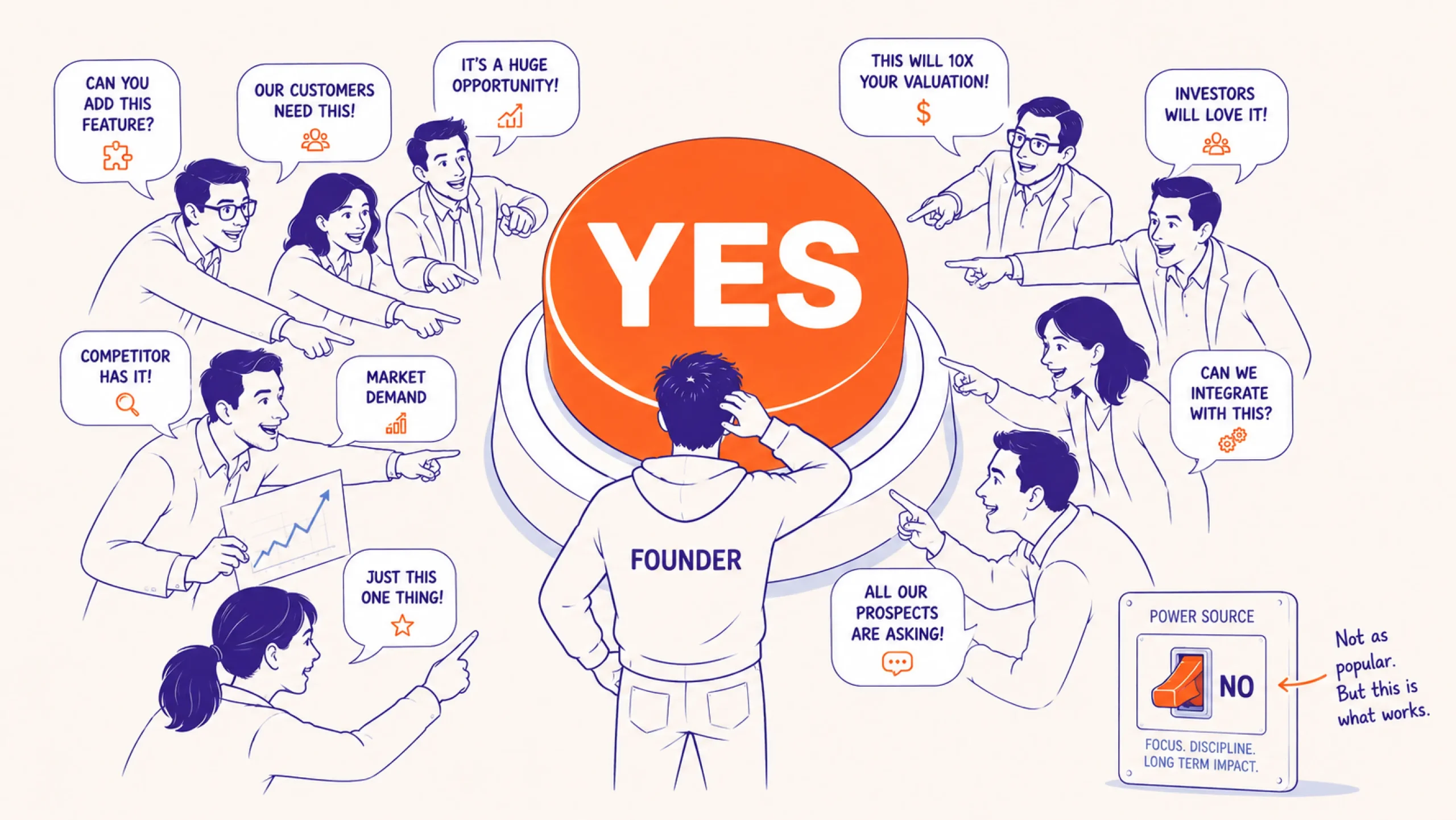
Every founder begins by saying yes. Yes to customers. Yes to feature requests. Yes to integrations. Yes to revenue.
The companies that scale eventually learn a different skill: knowing what deserves a no.
Pentathlon Ventures hosted a B2B ecosystem mixer with AIC Shiv Nadar University in Noida last month, bringing together founders and operators building in the thick of India’s enterprise technology wave. At the centre of the day was a panel discussion that cut straight to one of the most uncomfortable truths in B2B: the very thing that wins you your first customers, customisation, is often the same thing that stops you from reaching your hundredth.
At the B2B Ecosystem Mixer in Noida, I expected to hear a discussion about product strategy and development. What I ended up hearing was a discussion about focus.
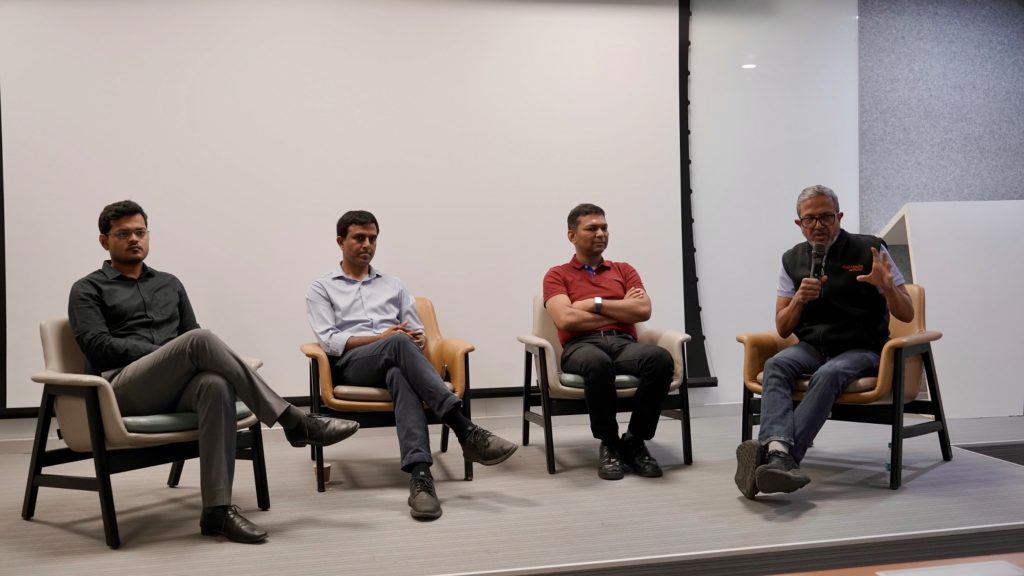
On the panel: (Left to right) Navjeet Kumar (Principal, Pentathlon Ventures), Sanjay Varnwal (Co-founder, Spyne), Mayank Gupta (Co-founder, Zopper), and Madhukar Bhatia (Managing Partner, Pentathlon Ventures).
The panel was titled “B2B Products: From Customisation to Scale.” On the surface, it sounded like a classic SaaS conversation. How much should founders customise for customers? When should they productise? At what point does customisation stop being customer-centric and start becoming technical debt?
But as the conversation unfolded, it became clear that the discussion wasn’t really about software at all. It was about knowing what deserves a yes and what deserves a no.
One story in particular stayed with me
Today, Spyne is one of India’s most exciting AI companies in automotive retail. But it didn’t start there. The company was building visual content solutions across multiple industries like food, fashion, real estate, and automotive. Revenue was growing. Customers were coming in. By most startup standards, things were moving in the right direction.
Most founders would look at that situation and conclude that the next step is expansion. More customers, more industries, more opportunities. Instead, Sanjay and his team made a decision that felt almost counterintuitive. They deliberately cut more than half their revenue and focused entirely on automotive.
At first glance, it sounds reckless. Why walk away from paying customers? Why reduce revenue when every startup is trying to grow it?
But Sanjay explained something many founders eventually learn the hard way. Five industries don’t simply mean five customer segments. They mean five GTM motions, five onboarding journeys, five customer success playbooks, and five product roadmaps. The company was accumulating knowledge, but it wasn’t compounding that knowledge. While trying to solve problems for five different types of customers, they weren’t going deep enough into any one of them.
The impact of that decision was remarkable. Once the company narrowed its focus, everything became clearer. Product decisions became easier because everyone understood the customer more deeply. Distribution became sharper because the ICP was better defined. Customer success improved because the same patterns appeared repeatedly. The team started speaking the same language. Growth followed. From that point onward, Spyne went on to triple its revenue year after year.
Listening to this story raised an interesting question in my mind. How do founders know whether customer requests are helping them discover the market or pulling them away from it?
For early-stage B2B companies, this question matters because almost every successful company begins with behaviour that looks fundamentally unscalable. Customers ask for features that aren’t on the roadmap. They ask for integrations that don’t exist, workflows nobody anticipated, and edge cases that seem impossible to generalise. Conventional startup wisdom often treats this as a problem to be minimised. The discussion suggested something different.
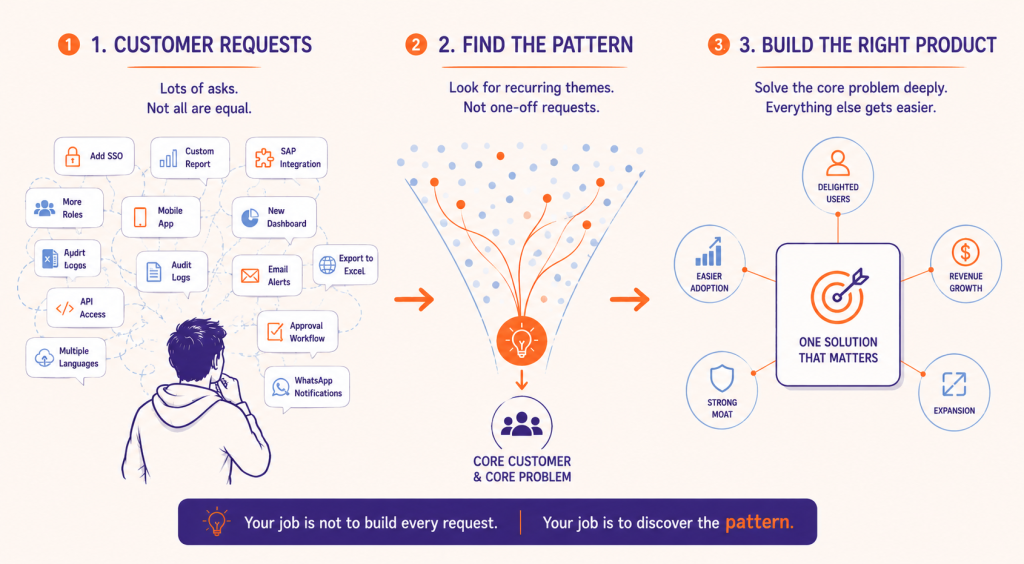
Customisation is not the enemy. Indiscriminate customisation is. You can’t cater to every request but it’s the founder’s job to find the right pattern within the plethora of requests and then build the right product which will serve a large number of customers.
The distinction became even more apparent when Mayank shared Zopper’s journey. Unlike Spyne, which found scale through narrowing its focus, Zopper operates in insurance distribution. A world filled with banks, NBFCs, retailers, OEMs, and legacy systems. In such an environment, customisation wasn’t something to avoid. It was often the only way to learn.
Their philosophy was simple. If a customer request helped solve a core business problem and could eventually improve outcomes across the ecosystem, they would build it. If it was merely a one-off preference that served a single customer, they would not. Over time, those learnings became the product itself.
At first, Spyne and Zopper seem to be telling opposite stories. One walked away from customers to focus. The other leaned into customer requests to learn. But beneath the surface, both companies were doing the same thing. They were searching for patterns with the largest potential. They not just found a pattern but they chose a pattern with the most market pull. Spyne decided correctly that scaling in the used car dealers will be easier. Zopper is also comparing the potential of a pattern in choosing one over others.Spyne found its pattern in a single vertical. Zopper found its pattern inside customer workflows. In both cases, scale came from choosing the right pattern with the biggest market pull. It is an exercise of looking at the potential of each pattern, more from a GTM perspective. Where will it be easier to scale?
One of the most insightful observations came from Madhukar’s investor perspective. He challenged something many founders worry about prematurely: looking scalable. There is a temptation today, particularly in the AI era, to build the perfect product from day one. A beautifully architected solution. A polished dashboard. A roadmap that feels complete.
The problem is that customers don’t buy architecture. They buy solutions to problems.
Sometimes the fastest way to understand those problems is by doing things that don’t look scalable at all. Sitting with customers. Helping onboard them. Building custom workflows. Doing things manually. Madhukar referenced the classic Airbnb story, where the founders personally photographed listings because hosts didn’t know how to present their homes online. Photographing houses wasn’t scalable. But it helped them understand the problem better than any dashboard or analytics report could have.
That distinction feels even more relevant today. AI has dramatically reduced the cost of building software, but it has not reduced the cost of understanding customers. If anything, the temptation to build before understanding has become even greater.
Several founders in the audience raised an interesting possibility. Could AI make customisation itself a competitive advantage? If software becomes easier to modify and maintain, perhaps the historical trade-off between flexibility and scale starts to disappear.
The panel’s answer was nuanced. The cost of customisation may fall. The importance of identifying patterns with market pull will not fall.
And that was perhaps my biggest takeaway from the evening.
The question isn’t whether you’re customising too much. The question is whether you’re learning from it.
What does it mean if every customer asks for something different?
If every customer asks for something different, perhaps the issue isn’t the product. Perhaps you’re selling to the wrong customer. If ten customers ask for the same thing, you’ve probably discovered your roadmap.
Scale, then, is not the absence of customisation. Scale is the ability to recognise patterns within it.
Every founder begins by saying yes. Yes to customers. Yes to feature requests. Yes to integrations. Yes to revenue. Survival often demands it.
But eventually growth requires a different skill: the ability to say no. No to the customer that pulls you away from your highest potential market. No to the feature that serves only one account. No to revenue that distracts from a much larger opportunity.
And perhaps that is the real transition from customisation to scale.
Not a product decision. A focus decision.
What is the journey of customisation to scale?
Viewed through that lens, the journey from customisation to scale is not really a product journey at all. It is a journey from experimentation to conviction. The founders who succeed are not necessarily the ones who customise the least.
In the beginning, founders customise because they don’t yet know what matters. In the end, conviction is simply the ability to recognise the patterns that matter most in the market and have the courage to build around them.
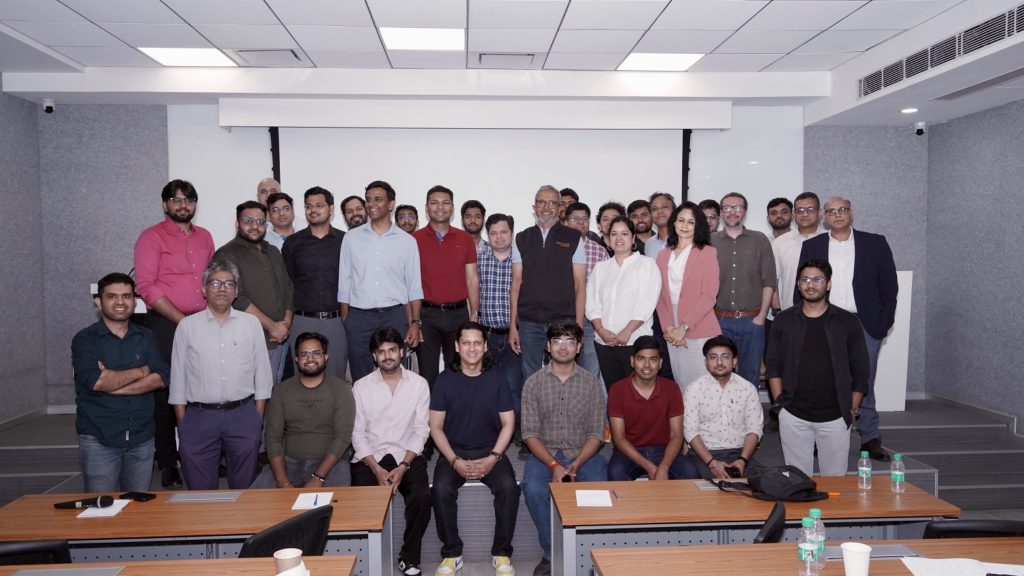
I’ll leave you with a picture of the founders, operators, and investors who spent their Saturday afternoon exchanging lessons, sharing mistakes, and helping one another navigate the journey of building B2B companies.
Nobody said entrepreneurship is easy. There won’t be a clean answer. Conviction may be wrong. But doing things without conviction can be even worse. The panel didn’t produce a clean framework or a tidy playbook. What it produced was something more useful: honest testimony from people who’ve navigated this terrain and lived through the trade-offs between customisation and scale, experimentation and conviction, saying yes and learning when to say no.
And perhaps that’s the real advantage of communities like these. The lessons that take one founder years to learn can sometimes be shared in a single afternoon.
Pentathlon Ventures hosts regular mixers and events for B2B founders navigating the earliest and most formative stages of building. If you’d like to be part of future conversations, reach out to us at [email protected] or subscribe to our newsletter on the website.