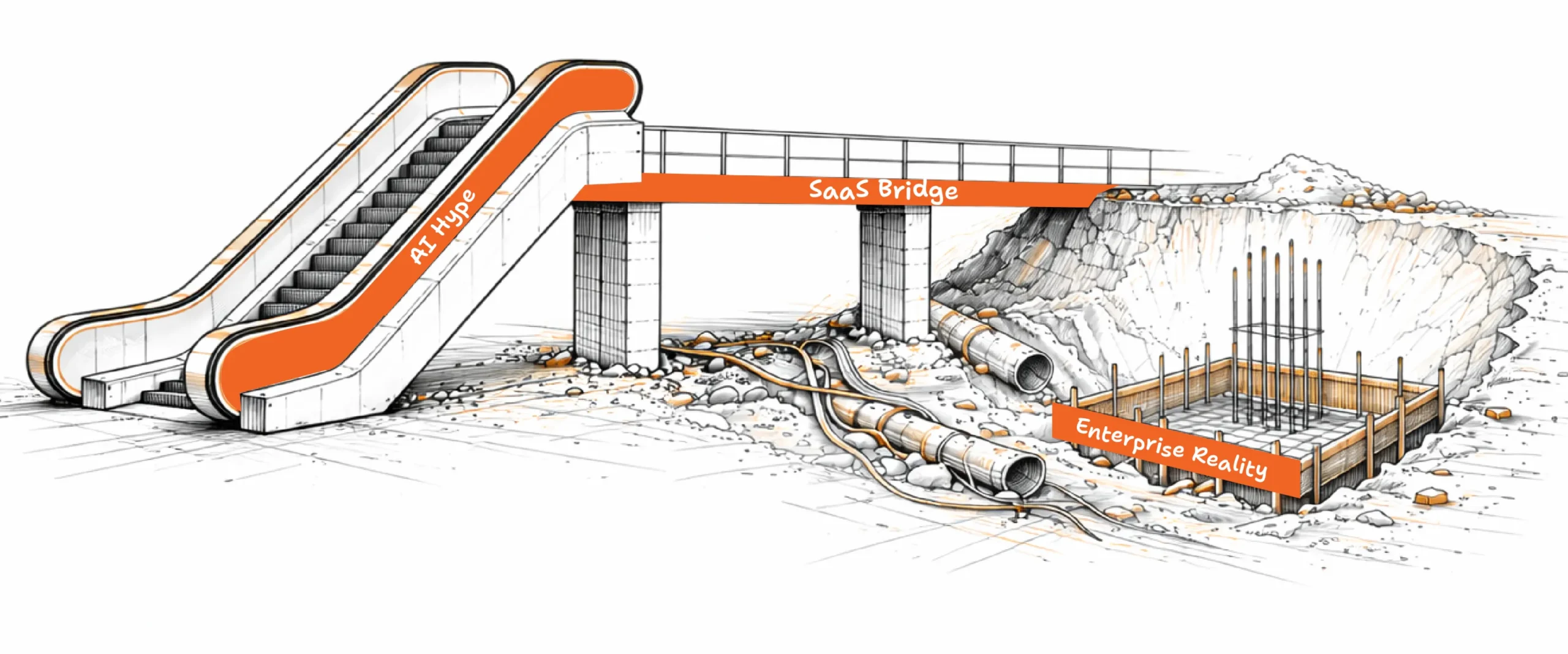

January 2024: Manisha Sharaf gets the email every B2B SaaS founder dreams of.
The LOI from ArcelorMittal is in. The SuperProcure team celebrates, the board updates get a little bolder, and the revenue model quietly assumes go‑live in “Q2 FY25.”
November 2024: the PO finally lands. Ten months of steering committees, InfoSec questionnaires, vendor registration forms, and “just one more approval.” The deal was “done” in January and yet it just took most of a year to become real. That’s the reality of enterprise sales.
Why founders still chase the enterprise mirage
Enterprise customers are a paradox. They bring logo credibility, larger contracts, and eventually more predictable revenue, but they also bring 8–10 month cycles, procurement black holes, and the familiar line on investor calls: “These two big deals are definitely closing next month.”
On Pentathlon Day in Pune, Pentathlon Ventures Managing Partner Sandeep Chawda brought together four founders – Manisha from SuperProcure (multi‑enterprise TMS), Vijay from Neurofin (AI‑driven secured‑lending platform), Sunil from TreZix (global trade and Ex‑Im automation), and Deepak from Dista (a BFSI‑focused AI company) – to talk about what it actually takes to win these deals with logos like JSW Steel, ArcelorMittal, AU Small Finance Bank and others.
What emerged was a playbook for B2B founders: expensive mistakes, hard pivots, and repeatable patterns.
If reading is not your thing, we have the video on YouTube as well, watch the entire video here.
The hunt: it’s never “one decision‑maker”
Most founders start with a simple idea: “If I just find the decision‑maker, I’m set.” The panel quickly kills that notion.
Manisha explains that in any serious enterprise deal, you’re really hunting for a trinity:
- A champion willing to take a risk and say “SuperProcure” in rooms where SAP and other incumbents are default choices
- The budget holder, often sitting in a different department like marketing, supply chain, or a central digital team
- The digital/AI team, a newer group that evaluates anything related to digitisation or AI, separate from core IT or business
In large banks this often sits inside a complex maze. There is IT, a business technology group, a strong InfoSec function and sometimes a separate sales head, each with its own agenda and veto power. Titles may look similar across enterprises but the power behind them can be very different.
So where do you start?
Sunil’s rule is simple. Find who is being hammered the most. That is your real entry point, the person staying late, fielding angry calls and manually patching broken processes. If you design your first conversation around that person’s pain, you create a natural champion but if you spray and pray across departments, your deal cycle explodes.
For B2B SaaS founders, the non obvious insight is that your ICP inside an enterprise is not “CIOs in manufacturing”.
The trust barrier: why should they bet on you?
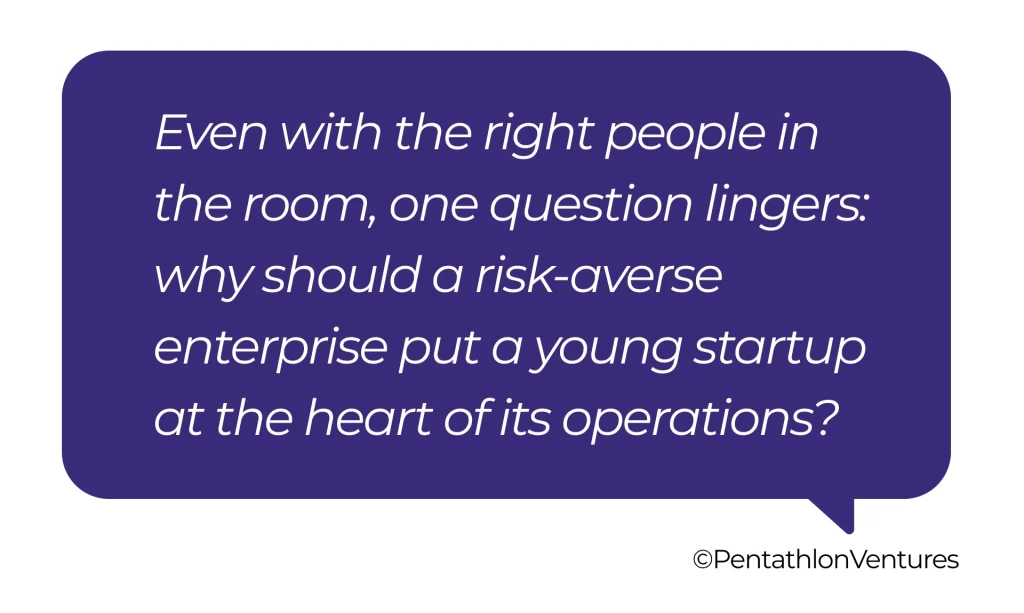
Vijay recalls Neurofin’s first major client. The product was young, the risk high and his pitch included a safety net: “If we don’t work, we’ll help you exit so you’re not stuck.”
That level of skin in the game created enough confidence to start. As Neurofin matured, the trust stack evolved: banks now ask for P&L and management depth, and the team shares numbers comfortably to prove durability.
More powerful than numbers, Vijay says, is speaking the customer’s language. It’s the difference between saying “we automate operations” and saying, “50% of your volume hits in the last two days of the month; your real operations problem is compressed into 48 hours.” When a risk or ops head hears that, they feel understood, something few vendors manage.
Manisha shows how brand borrowing works in the early days. Simply adding “incubated under IIM Calcutta” to emails changed how enterprises responded to SuperProcure. It was a simple way to build credibility quickly.
Deepak leaned first on friends‑and‑family logos and trusted influencers, then on similar‑industry references once the product had survived real enterprise environments. Vijay went further on transparency with another client showing only slides when the product didn’t exist yet, openly admitting the gap, and offering co‑creation in return for early commitment.
Underneath these tactics is a shared model Vijay articulates cleanly: trust is built in layers – person first, company second, product third. If they don’t trust you, the rest doesn’t matter.
Once they trust you, they check that the company will survive. Only then do they deeply interrogate the product.
The gauntlet: procurement, security, and parallel threads
The emotional work of trust is only half the game. The other half is surviving the gauntlet of process.
Manisha breaks SuperProcure’s large‑deal motion into five rough stages:
- The customer builds the business case
- Management gives broad approval and vendor evaluation begins
- IT, business, or digital teams lead solution evaluation
- Procurement, security, and legal step in
- Documentation, contracts, vendor registration, and the final PO
Manisha’s view is that the real work happens before paperwork even starts. If you are present while the business case is being shaped, most of the sale is already in motion because the problem, approach and success metrics are being defined in your language.
The procedural side has become heavier in the last couple of years. InfoSec checklists that were two pages are now closer to six, and large enterprises often involve CSOs, security teams and sometimes third party audits, especially in BFSI where RBI scrutiny on data and AI is rising.
Her response is to thread the process in parallel. As soon as a serious sponsor appears, she starts security review, vendor registration and legal work at the same time instead of waiting for a final yes. In the ArcelorMittal case, LOI arrived in January 2024 and the PO in November 2024, mostly due to documentation. Parallel threads didn’t make it fast, but they stopped it getting even slower.
Vijay focuses on reducing friction. If a client wants a different jurisdiction, Neurofin agrees. If procurement insists on their NDA, the team accepts it and only pushes back on a few non-negotiables such as avoiding unlimited liability. They do not fight for perfectly mutual terms when the buyer holds the leverage.
He also uses an investment gradient. First a quick proof of concept, then an integrated pilot with light commercials, then deeper integration. At each step the client commits more time, data and internal capital, which makes a late “no” less likely.
Most on the panel now prefer paid pilots over free ones. Even a ₹10,000 pilot needs a purchase order, an approver and clear KPIs, which creates ownership inside the client. Free pilots often stay invisible, with no budget, no accountable owner and no report back, even if you perform well.
Channels and alliances: when partners help
Sooner or later, founders ask: “Can channel partners sell this for me?”
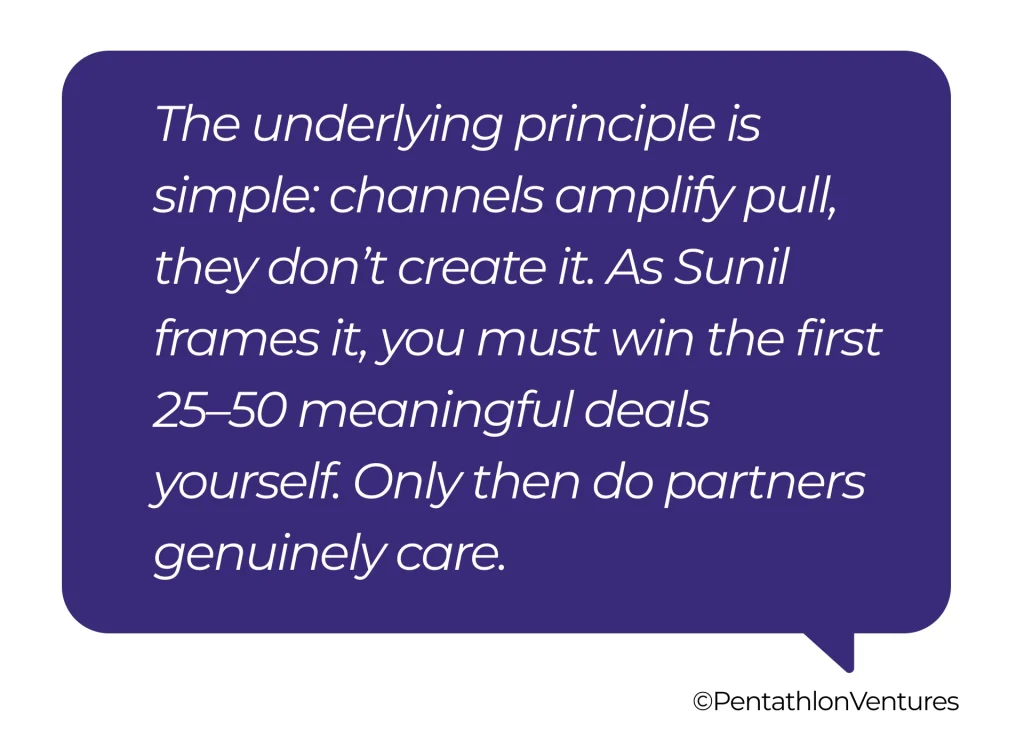
For these four founders, the answer is mostly no, at least in the early years. Sunil is clear that for consultative, workflow heavy SaaS, traditional dealers and distributors are a poor fit because they are set up to sell standard products, not to drive complex process change inside enterprises.
What has worked for TreZix is a more nuanced mix:
- OEM ecosystems like SAP, Oracle, or AWS marketplaces that signal credibility and integration into existing enterprise stacks
- Strategic advisory alliances with Big Four firms such as Deloitte, where TreZix becomes part of the recommended toolkit for trade and compliance transformation
Geo‑specific partners in markets like Mexico, where local language and relationships matter, while the core team still leads the sale
The new game: 2024–25 shifts
The buying environment is shifting and founders need to adjust.
Vijay now sees AI champions inside large customers, people who sit next to digital and CTO teams and shape every AI related proposal even if they do not own budget. In parallel, InfoSec has become tougher, with longer questionnaires, more reviewers and, in BFSI, tighter RBI led standards on data and AI risk.
Sunil notes that boards are asking direct questions on AI and efficiency, such as what the company is doing with AI and how it plans to grow without adding equivalent headcount. They want clear cost savings and cleaner, shared data across teams. Deepak adds that procurement is more cautious, prefers shorter terms and revisits every rupee.
For founders selling in 2026, this means four things.
- Design with InfoSec in mind from day one
- Identify AI champions as explicit stakeholders
- Offer pricing that works with shorter commitments
- Be ready for enterprises that want to learn from startups but will test them harder
Test cricket, tournament, or yoga?
Towards the end of the session, Sandeep throws a seemingly casual question at the panel:
“If selling to large enterprises was a sport, what would it be?”
Deepak says test match cricket. You show up day after day, many sessions feel slow, and then one breakthrough shifts the game.
Vijay thinks of it as a tournament because you clear one round and move to the next, with higher stakes each time and a real chance of losing late despite months of work.
Manisha’s analogy is yoga for a child. The sale is convincing the parent to hire the teacher and success is the child showing up every morning. In SaaS terms, closing the deal is not enough, adoption and daily use are what create value.
Deepak adds that enterprise sales is a team sport on both sides. If only one founder shows up every time, customers start to question the bench. On a large deal, they brought multiple co-founders and leaders to mirror the client’s 8 to 10 person delegation and signal depth.
Manisha closes with a simple habit. Record every meeting, send clear minutes to both teams and use that as the base for follow ups. Over a long, multi step cycle, disciplined memory becomes an edge.