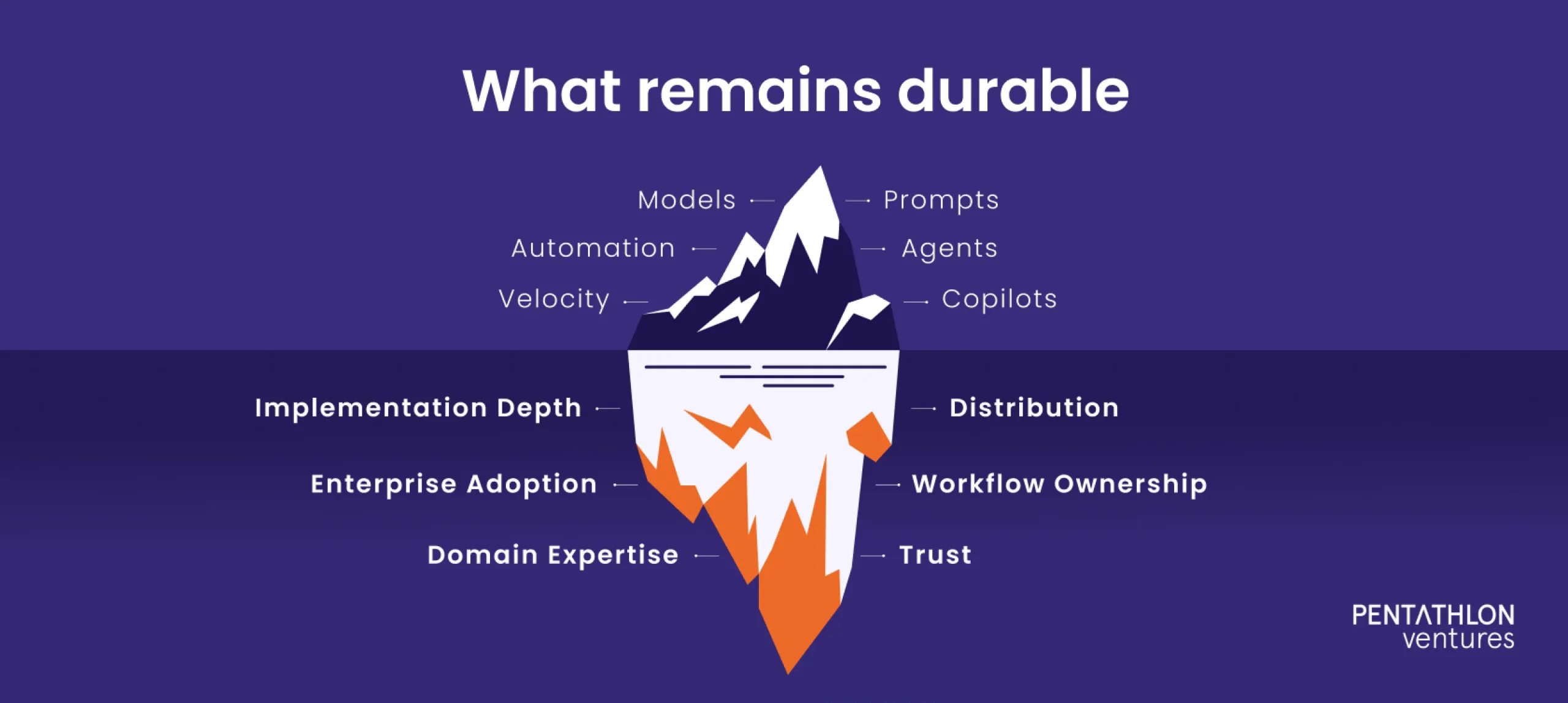
Jeff Bezos put it plainly: instead of asking what is going to change, ask what will not change in the next ten years. While dramatic shifts are coming in the next decade, nobody knows which ones will land or how long they will take. For a fund investing over the next five to eight years, that uncertainty makes the second question far more useful than the first.
The noise is loudest right now. So, in the context of early-stage B2B tech, here is what we think stays constant.
Enterprises adopt deliberately
Enterprises will always want to serve their customers better and do it more efficiently. Technology helps. But they will not risk surprising those customers, which means however fast technology moves, enterprise adoption stays cautious.
Top-down mandates backed by heavy spending are not producing returns. What is working is bottom-up adoption, employees using technology as an assistant for specific tasks, not company-wide autonomous workflows. Deeptek.ai, one of our portfolio companies, does precisely this at scale for radiologists across India, South-East Asia, and the US.
Indian buyers move on regulation and growth
Indian enterprises stay price-conscious and slow to decide. SMBs even more so, though their sheer number is the attraction. Their primary reasons to adopt technology stay constant: regulation, and top-line growth. Adoption is fast when technology drives revenue, slow when it only promises efficiency.
Tally has compounded for over three decades on exactly this logic. A compliance trigger millions of buyers cannot skip. Our portfolio company Shopse has seen strong traction for the same reason, helping merchants across India enable BNPL and grow their top line.
Distribution is the moat
Well-networked, trusted founders win the first revenue. Customer trust and expansion within accounts drive the growth that follows. Warm introductions and word of mouth create the cycle that sustains it.
Cold outreach is finished in B2B. Reply rates on cold sequences sit below 3% and keep falling. Volume is no longer a moat. Depth and quality of network is. Spyne.ai, a portfolio company, cracked the used-car dealer segment in the US by entering through the North American Dealers Association and then expanding its solutions across that relationship. That is what distribution-led GTM looks like in practice.
Friction reduction wins
The lasting winners reduce friction in adoption, solve the enterprise problem well, and keep expanding until they become critical to the customer. They know their industry and domain cold. Whether a solution is labelled tech or services matters less than whether it is reliable and cost-effective.
The signal worth noting: even frontier model companies are now deploying Forward Deployment Engineers at customer sites, because enterprise adoption needs implementation, evaluation, fine-tuning, and integration alongside the product. Fable Fintech, a leader in cross-border remittance solutions white-labelled to leading banks in India and global customers, has operated this way from the start, deploying their team with customers to ensure the solution actually takes root.
Where the opportunities are
Everybody knows the four things above. The differentiation lives in the “how.”
Pricing is one clear example. In the US, usage and outcome-based models reduce adoption friction. In India, seats bundled with services reduce it, because predictable costs matter more to buyers. The winners work close to the ground rather than copying templates from another market.
The gap between how fast technology changes and how slowly organisations change is itself an opportunity. Picks-and-shovels plays, frugal solutions that speed up adoption, and infrastructure that sits between the new technology and the legacy organisation are all live categories.
If distribution is the moat, go-to-market becomes the differentiator. The B2C2B model that carried Indian developer tools to global scale in the last era, selling to enterprises through communities of individual users, can carry new products in this one.
Some founders will find inventive ways to win Bharat, the non-metro India that was hard to reach until the India Stack made it reachable. UPI, ONDC, and Account Aggregator have changed what is possible. Some of those winners will take their models global. And because the physical world is not going anywhere, manufacturing and biotech remain live territory for founders who can compress the deeptech build timeline enough to fit a fund’s horizon.
What this means for us
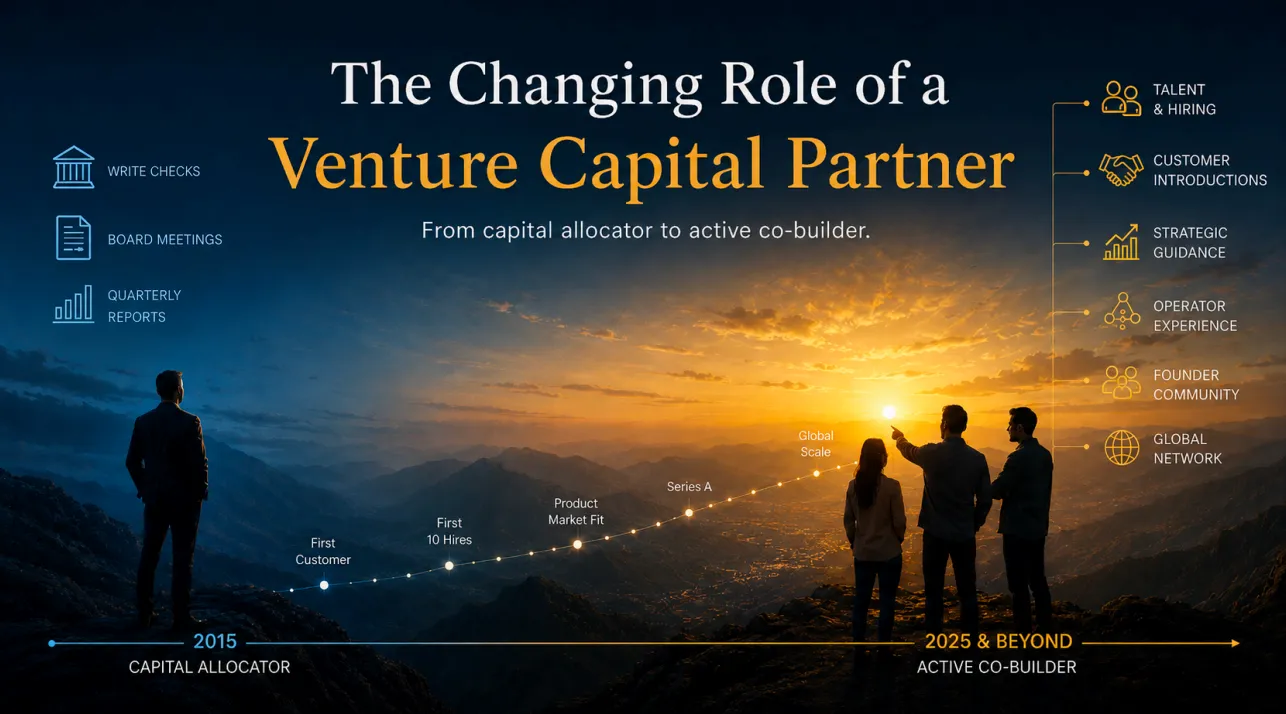
“What will not change” is a stable place to stand when everything else is moving. Our B2B tech focus does not change. But new opportunities and challenges arise alongside new developments, and we will keep working closely with our founders to ensure they are ahead of those changes and positioned to come out as winners. That is what the operating and technology background we bring is for.